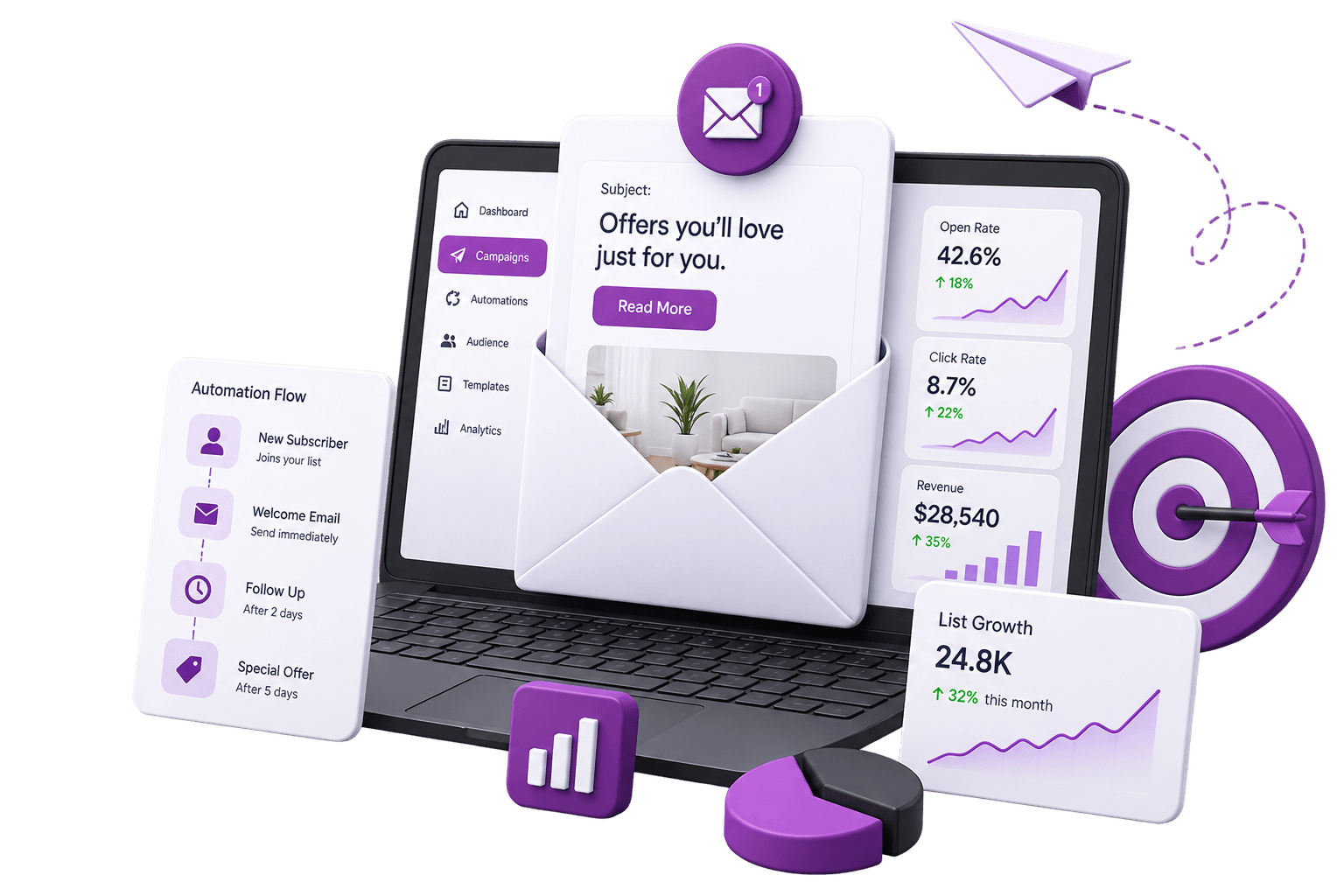
Email Marketing IntelligenceThe metrics that matter — and what they actually reveal about your subscribers.
Every email metric is a behavioural signal. Most businesses read these numbers as performance scores. Nexavative reads them as diagnostic data — what the number reveals about the subscriber relationship, and where the system needs to be corrected.
Open Rate
The Trust Meter
Open rate is not a content metric. It is a trust metric. A declining open rate is not a subject line problem. It is a relationship problem accumulated over multiple sends.
Industry Average: 21.33% across all industries
PsychologyDriven by sender name recognition, subject line curiosity gap, and inbox position at time of delivery — in that order.
Click-Through Rate (CTR)
The Relevance Signal
CTR measures whether the content matched the expectation created by the subject line — and whether the CTA was compelling enough to interrupt reading. Low CTR on a high open rate means the subject line worked but the content did not follow through.
Industry Average: 2.62% (good performers: 4–6%)
BehaviourThe click is a micro-commitment. It follows attention → interest → desire → action, compressed into a single email.
Conversion Rate
The System Performance Metric
Conversion rate is where email and business outcomes connect. Low conversion on high CTR is a landing page problem, not an email problem. The funnel breaks at the handoff.
E-commerce Average: 2–5% per campaign send
FunnelConversion requires subject line, CTA, and landing page to keep one psychological thread. Any break reduces conversion.
Deliverability Rate
The Foundation Metric
A 95% delivery rate does not mean 95% reached the inbox. Promotions tab and spam are both “delivered.” True inbox placement is sender reputation, engagement history, and authentication.
Target: Inbox placement rate above 90%
Technical TrustISPs apply social-proof logic — if most subscribers ignore you, they assume the content is unwanted and deprioritise delivery.
List Segmentation
The Relevance Architecture
Segmentation groups subscribers by behaviour, purchase history, journey stage, or interest so each group receives communication relevant to their situation. Unsegmented lists produce broadcasts. Segmented lists produce conversations.
Impact: Segmented campaigns produce 760% more revenue
PersonalisationRelevant content activates the personalisation effect — people respond more favourably to messages that feel written specifically for them.
Behavioural Triggers
The Timing Advantage
Cart abandonment, product page visits, opens without purchase, inactivity — each is a signal of a psychological state. Triggered emails reach the subscriber when intent is highest.
Performance: Triggered emails produce 3× higher open rates than campaigns
TimingAn email sent in response to behaviour arrives when the subscriber is already thinking about the topic. That timing alone doubles effectiveness.
Sender Reputation
The Trust Infrastructure
ISPs score your domain on spam complaints, bounces, engagement, and SPF/DKIM/DMARC. A damaged reputation can make every future email invisible. It takes weeks to damage and months to repair.
Critical Threshold: Spam complaint rate below 0.1%
AuthoritySender reputation works like human trust — built slowly through consistent behaviour and destroyed quickly by a single violation of expectation.
Revenue Per Subscriber (RPS)
The True Performance Metric
RPS measures how much revenue each person on the list generates over a period. A list of 1,000 subscribers generating £50 RPS produces more value than 10,000 at £3 RPS.
Benchmark: $1–5 RPS/month for optimised e-commerce lists
Business IntelligenceRPS reframes the list as a business asset with a quantifiable value — making investment decisions rational rather than intuitive.
Unsubscribe Rate
The Honest Feedback Signal
An unsubscribe is not a failure. It is the most honest signal a subscriber can give. The failure is not acting on the pattern before it damages deliverability.
Acceptable Rate: Below 0.5% per campaign send
Loss AversionAn easy unsubscribe improves deliverability — because people who cannot opt out use the spam button instead, which damages reputation far more.